Holiday Trash and Recycling Collection Schedule
Thanksgiving Holiday Reminder
Regular trash and recycling service will occur on Friday, November 27, 2026 (the day after Thanksgiving). As a friendly reminder, please place all trash (and recycling) containers at the curb by 7:00 a.m. to ensure collection.
Christmas and New Year’s Holiday Schedule
Please note that both Christmas Day (Friday, December 25, 2026) and New Year’s Day (Friday, January 1, 2027) fall on a regular trash and recycling collection day.
In accordance with our service agreement with Best Trash, there will be no trash or recycling collection on either of these holidays.
Trash Collection Schedule
- Following Christmas Day, trash will be collected on Tuesday, December 29, 2026.
- Following New Year’s Day, trash will be collected on Tuesday, January 5, 2027.
- As a friendly reminder, please have all trash containers at the curb by 7:00 a.m. on collection day.
- Regular trash collection service will resume thereafter.
Recycling Collection Schedule (applies only to residents whose regular recycling collection day is Friday)
- Recycling service will not resume until Friday, January 8, 2027.
- Please place all recycling containers at the curb by 7:00 a.m. on collection day.
- If you have more recyclables than will fit in your recycling cart, please place the excess materials in clear bags and/or boxes next to your cart for collection.
Please note that increased holiday waste volumes may result in later-than-usual collection times.
If you have any questions, please contact Best Trash Customer Service:
- Phone: (281) 313-2378
- Email: support@besttrashtexas.com
Thank you for your patience and cooperation. We wish you and your family a safe, happy, and memorable holiday season!
Ever Wonder Where Your Water Comes From… and Where It Goes?
Harris County MUD 354 directors take a behind-the-scenes look at Fairfield’s water and wastewater facilities.
Most of us don’t give much thought to the water we use every day. We turn on the faucet and expect clean water to come out. We take showers, wash dishes, and flush toilets without really thinking about where that water comes from or where it goes afterward. It’s something we tend to take for granted, but providing those services requires an incredible amount of equipment, infrastructure, and work that most residents will never see.
On November 5, members of the Harris County Municipal Utility District No. 354 Board of Directors had an opportunity to see that work firsthand when employees from Inframark took us on a tour of Fairfield’s wastewater treatment plant off Cypresswood Drive and two of the community’s water plants near Ault Elementary School and CVS. The purpose of the visit was to better understand the systems our residents depend on every day, but it also gave us a much greater appreciation for the people responsible for keeping everything running.
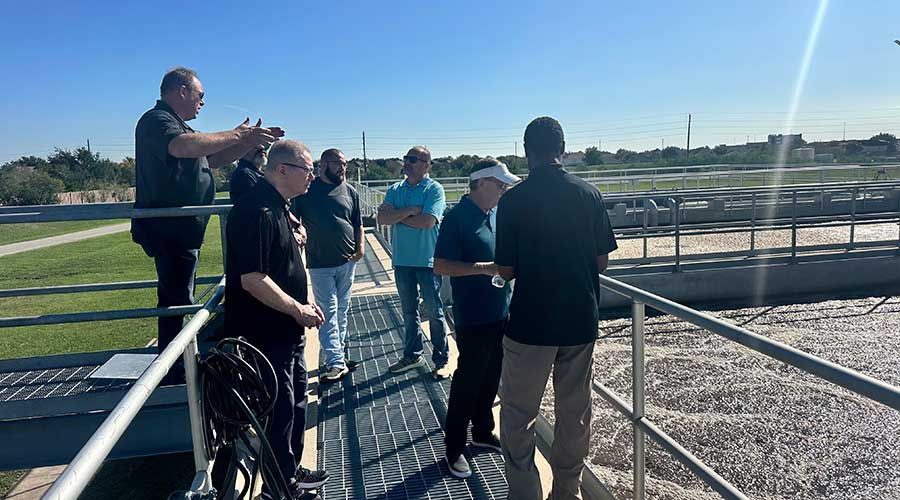
MUD 354 directors and Inframark employees discuss the wastewater treatment process during a tour of Fairfield’s facilities on November 5, 2026.
From the Drain to the Wastewater Treatment Plant
Our first stop was the wastewater treatment plant, where the water that disappears down our drains and toilets eventually ends up. Wastewater travels through an extensive network of underground sewer pipes, with lift stations helping move it toward the treatment facility. Once it arrives, the process begins by removing materials such as rags, plastics, wipes, and other debris that could damage the equipment. This is one reason residents should never flush wipes, even those labeled “flushable.” These materials can clog pumps and pipes, creating problems that are both expensive and time-consuming to repair.
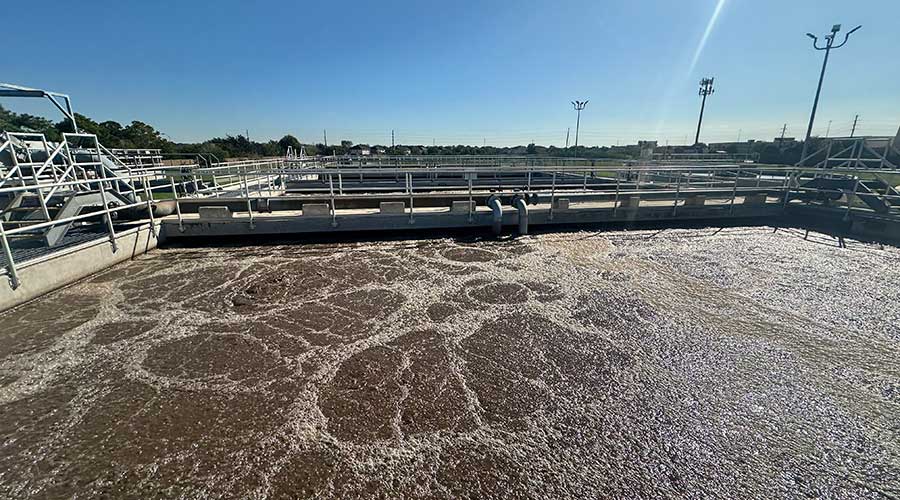
Large aeration basins use oxygen to support microorganisms that help break down organic waste during the treatment process.
After the larger debris is removed, the wastewater moves through a series of treatment stages that were fascinating to see in person. In large aeration basins, air is pumped into the water to provide oxygen for microorganisms that naturally break down organic waste. The water then moves into circular tanks called clarifiers, where remaining solids settle to the bottom and are separated from the water above. The treatment process continues with disinfection and other required steps before the treated water is released back into the environment under regulated discharge requirements.
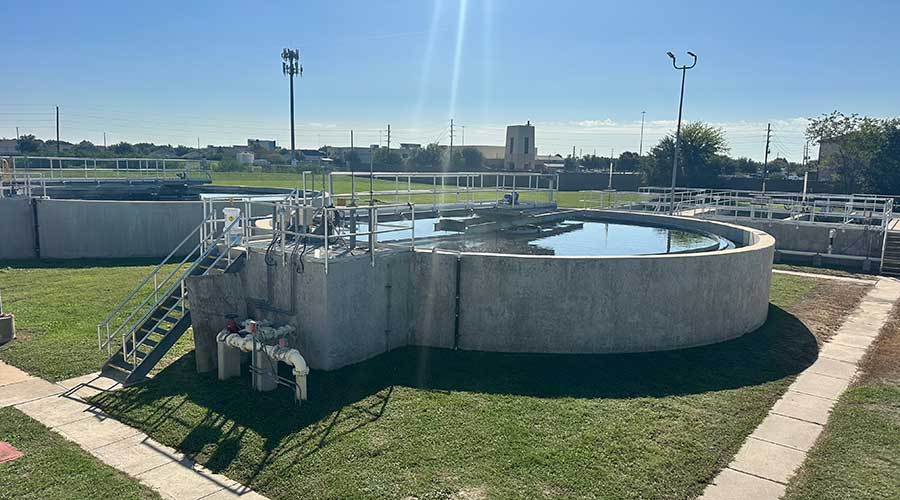
A circular clarifier helps separate remaining solids from wastewater as it moves through the treatment process.
What impressed us most was seeing the difference between the wastewater entering the plant and the remarkably clear water emerging near the end of the process. It was hard to believe that the two were part of the same system. According to Inframark’s August 2026 operating figures, Fairfield’s wastewater treatment plant processed an average of approximately 1.49 million gallons of wastewater every day. Seeing the size of the equipment required to handle that volume, along with the transformation taking place throughout the facility, gave us a new appreciation for a process that most of us never think about.
From Underground to Our Faucets
From there, we visited two of Fairfield’s drinking water plants, where we learned what happens before water ever reaches our homes. Fairfield’s drinking water is drawn from wells that tap into the Gulf Coast Aquifer system beneath our region. Once brought to the surface, the water is disinfected, stored, and delivered through a network of pumps and pipes that supply the community. We were particularly impressed by the size of the equipment involved. The pumping systems, large water storage facilities, and hydropneumatic tanks are much more substantial than most people would probably imagine. Those hydropneumatic tanks use compressed air to help maintain water pressure throughout the distribution system, allowing residents to enjoy reliable water pressure when they turn on their faucets.
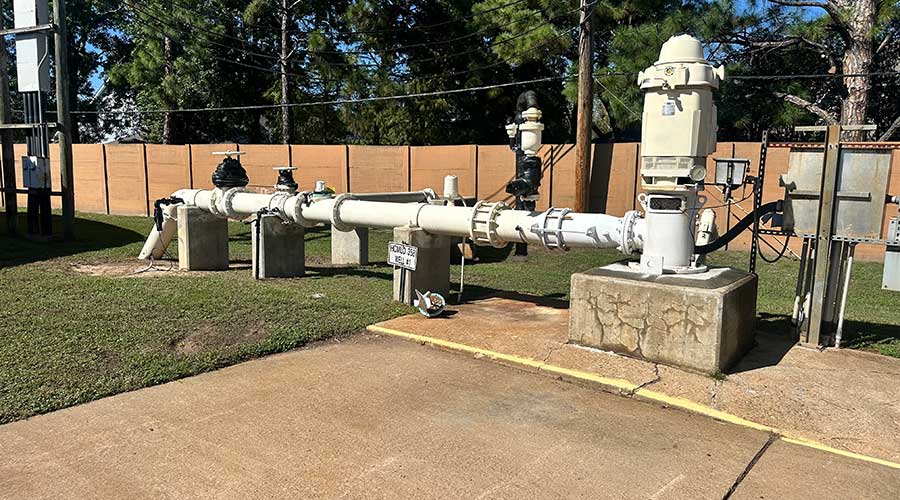
One of Fairfield’s groundwater wells, where water is pumped from the aquifer beneath our community.
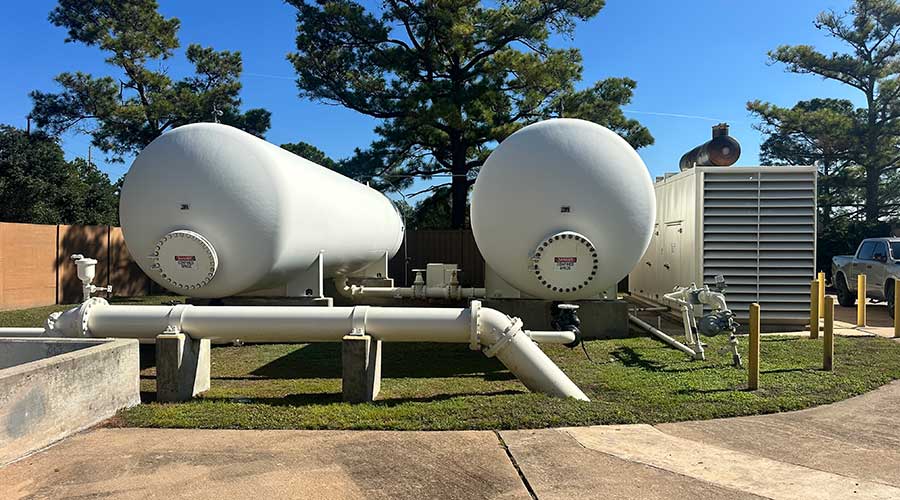
Large hydropneumatic tanks use compressed air to help maintain water pressure throughout Fairfield’s distribution system.
The amount of water moving through these facilities is equally impressive. According to Inframark’s September 2026 operations report, the Fairfield regional water system pumped more than 143 million gallons of water during that month. During the August 21 through September 22 billing cycle, nearly 41 million gallons were billed to customers in MUD 354 alone. Those figures help put into perspective the demands placed on our infrastructure and the importance of maintaining the equipment that supplies water to our neighborhoods.
Maintaining Fairfield’s Water Infrastructure
All of this infrastructure also comes with considerable operating and maintenance costs. Fairfield’s water and wastewater facilities are part of a regional system owned by Harris County MUD 358 and shared with neighboring MUDs 322, 354, 396, and 397. Through this arrangement, the districts share the costs of operating and maintaining facilities that serve the broader Fairfield community. Residents contribute to these essential services through their monthly water and sewer payments, while MUD property taxes help support each district’s broader operating, maintenance, and infrastructure responsibilities. To put the scale of those expenses into perspective, MUD 358’s audited financial statements show that the regional system spent approximately $2.8 million on repairs and maintenance in 2025 alone. Keeping everything operating requires electricity, chemicals, laboratory testing, equipment repairs, routine maintenance, and continued investment in aging infrastructure.
The Unsung Heroes Behind Our Water
While the facilities and equipment were impressive, one of the things that stood out most during our tour was the professionalism and dedication of the Inframark employees who showed us around. Tyjon Jordan, Juan Olivo, and Timothy took the time to explain each part of the process, answer our questions, and share their knowledge of the systems they maintain. It was clear that these gentlemen not only understood their work extremely well, but also genuinely cared about the important service they provide to our community.
We learned that Inframark maintains an around-the-clock emergency response capability, with employees available to respond when problems arise, whether during normal business hours or in the middle of the night. When a pump fails, a water line breaks, or something goes wrong at a treatment facility, these are the people responsible for helping get things working again. Much of their work happens out of sight, and when everything is operating as it should, most residents have little reason to think about it.
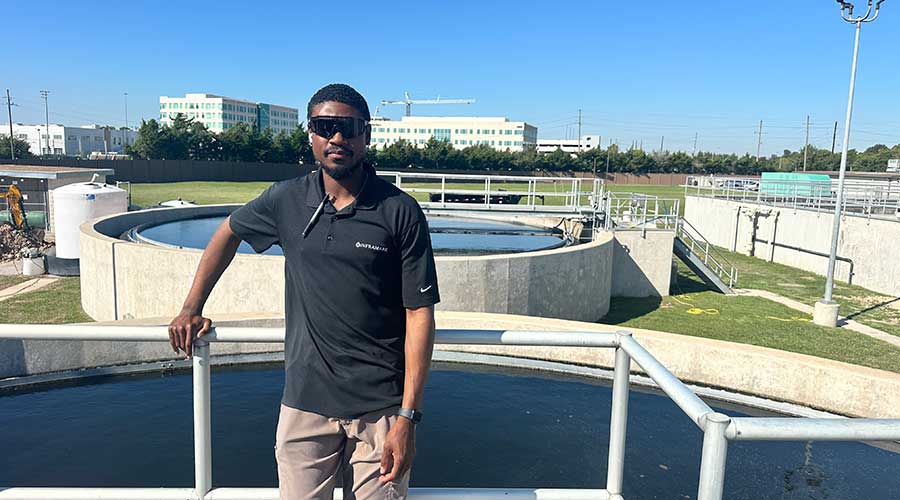
Inframark’s Tyjon Jordan, one of the employees who guided MUD 354 directors through Fairfield’s water and wastewater facilities.
That may be the greatest takeaway from our visit. Behind the water coming out of our faucets and the wastewater disappearing down our drains are people who work every day to protect public health and keep our community running. Tyjon, Juan, and Timothy, and the rest of the Inframark team are, in many ways, the unsung heroes of our neighborhood. We are grateful for their dedication and appreciate the time they spent helping us better understand the work they do.
As members of the MUD 354 Board of Directors, we believe it is important to understand the infrastructure our residents depend on, the work required to maintain it, and how residents’ water bills and tax dollars help support these essential services. Our visit gave us a greater appreciation for the complexity of Fairfield’s water and wastewater systems and, more importantly, the people who operate them. The next time you turn on your faucet or flush your toilet, we hope you’ll take a moment to consider everything happening behind the scenes to make those simple conveniences possible. There’s a lot more to it than most of us realize.
Information Regarding Your Child’s E-bike, Mini Motorcycle, or other Micromobility Devices
Dear Residents,
The Fairfield MUD Boards are working with Harris County Constables, Precinct 4, to distribute information on micromobility devices. Many of these devices, such as electric assisted bicycles, motor assisted scooters, electric personal assistive mobility devices, mopeds, or pocket bikes/mini motorcycles, are being used on Fairfield streets, sidewalks, and channels and the rules for their use are not well-known.
Please review this information so that you know and can educate your children about where they can ride their devices and the rules of the road pertaining to each type. The Constables will be enforcing these rules. And remember no motorized vehicles are allowed on the Fairfield channels or detention ponds.
Following these rules is important for the safety of all Fairfield residents. Please share the sidewalk and/or road with other modes of transportation and walkers!
Flock Cameras Coming to Fairfield
At the request of the Precinct 4 Constables in Fairfield, the Fairfield MUDs have joined together to fund the installation of Flock cameras at the entrances to and exits from Fairfield. Flock cameras read and record license plate numbers. This data is only accessible by law enforcement officers and helps them trace stolen cars, serve outstanding warrants and identify theft rings, among other uses. They are widely used in Houston and the surrounding neighborhoods.
The cameras are being installed in phases by Flock Group Inc. (“Flock”) under a contract among Flock, Harris County, and Harris County Municipal Utility District No. 358. The remaining Fairfield MUDs have entered into a cost sharing agreement with MUD 358. Flock must obtain a separate permit from Harris County for each Flock camera it installs. Therefore, there is no set time for completion.
For more information about Flock cameras generally, please see the attached publications developed by Flock which answer commonly asked questions. If you have any comments or questions about Flock cameras in Fairfield, please go to www.fairfieldmuds.org and insert your comments in the comment box that appears when you select Contact Us. You may also address the Board at any public meeting of the MUDs. The meeting schedule is set forth on the website.
The Fairfield MUDs believe the Flock cameras will help to deter criminal activity in Fairfield and enable the Constables to identify suspects. We will be analyzing their effectiveness over time and will make adjustments as needed.
Your Fairfield Municipal Utility Districts
Updated Master Sidewalk Improvements Plan
The Board of Directors of Harris County Water Control & Improvement District has updated its master plan for sidewalk installation along the channels in Fairfield. The District is currently working on Phase 2 of the Plan.
The Board meets on the fourth Monday of the month at 5:30 p.m. at the Bradford Creek Clubhouse. The public is invited to attend and provide comments.


Notice to Sellers & Purchaser
Notice to Sellers & Purchasers
No Current Updates
There are currently no District updates. Check back for the latest news of what’s going on within the District.